Other ball sports history
Autres sports de balle
Les jeux de paume ont une origine très lointaine. Déjà dans l’Antiquité, les Grecs pratiquaient un jeu aux règles identiques : “la Phaeninde”. Plus tard, le ballon au poing gagna la Gaule grâce aux Romains et s’installa comme
ertissement au Moyen Age. Louis XIII jouait également au ballon au poing.
Les règles du jeu :
Un grand principe : le “gagne terrain”. Le ballon est frappé à l’aide du poignet protégé par une bande de toile. Le foncier de l’équipe côté tir, engage la partie. Il doit envoyer le ballon au-delà de la ligne de corde. Les deux équipes composées de 6 joueurs, répartis sur l’ensemble du terrain (longueur : 65 m ; largeur : 12 m), se renvoient directement le ballon de volée ou du premier bond (les passes étant interdites). Dans le cas où le ballon n’aurait pu être renvoyé avant le 2e bond (que celui-ci se fasse à l’intérieur ou à l’extérieur du terrain), on repérera le point où il aura été arrêté, ou l’endroit où il aura coupé la ligne par le placement d’un petit piquet mobile appelé “chasse”. Cette “chasse” sera posée sur une des lignes longitudinales du terrain au point extrême atteint par le ballon. La chasse indique donc une ligne imaginaire qui sépare le terrain en 2 parties. Quand elle est posée, les 2 équipes changent de camp. Il s’agit maintenant pour elles d’envoyer le ballon dans le camp de l’adversaire ainsi délimité, de sorte que ce dernier ne puisse le reprendre et marquer ainsi un “quinze”. Pour marquer un jeu, il faut quatre “quinze” (15, 30, 40 et jeu). L’équipe qui la première atteindra 7 jeux s’adjugera le gain de la partie.
Le ballon pèse 500 g et est en vessie de caoutchouc à valve recouverte de cuir de vache.
Le ballon au poing est surtout pratiqué en Picardie et compte 2 000 joueurs.
Jeu de balle descendant de la longue paume. Il a, par des formes variées, traversé les civilisations pour arriver au siècle dernier en 1870 (introduit par des tonneliers italiens) à sa forme moderne, et prendre alors le nom de l’instrument utilisé pour frapper la balle.
Ce jeu se joue comme le tennis mais sans filet avec le même décompte.
La rencontre de 2 équipes de 5 joueurs évoluant en 2 camps opposés donne le caractère de sport d’équipe où l’in
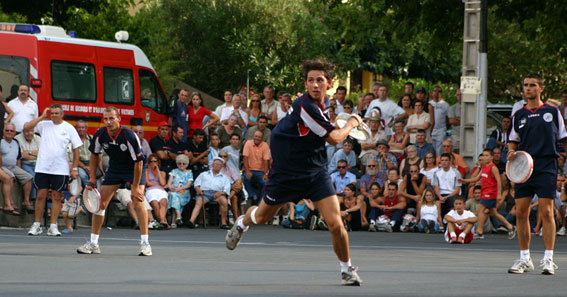
idualité domine à chaque échange de balle. Par le biais d’une balle lancée jusqu’à 250 km/h, les joueurs relancent sans cesse sur le terrain (goudron ou terre battue).
Les parties sont donc comptées à la façon du tennis (15, 30, 45 puis jeu) et se gagnent en une manche de distance de 16 ou 13 jeux selon les catégories avec application de la règle de l’avantage en cas d’égalité à 45.
Quelques règles :
Les limites du terrain font partie intégrante de l’aire de jeu. La ligne médiane s’appelle “basse”. Les équipes changent de camp tous les 3 jeux. La balle peut être frappée à la volée ou au premier bond.
On perd le quinze quand :
Le batteur, exécutant le service, empiète sur la ligne de fond et entre dans le terrain de jeu.
La balle, lancée ou relancée, ne dépasse pas la ligne médiane ou sort des lignes du périmètre du terrain.
La balle est renvoyée avec n’importe quelle partie du corps à l’exception de l’avant-bras qui tient le tambourin.
La balle est touchée successivement par plus d’un joueur de la même équipe.
Un joueur pénètre dans le camp adverse.
Les joueurs : deux “Fonds” dont un, le batteur, assure la mise en jeu, un “Tiers” et deux “Cordiers”.
Le tambourin mesure 28 cm de diamètre.
Pour la seule mise en jeu : le battoir, 18 cm de diamètre et prolongé d’un manche (80 à 100 cm hors tout).
Le jeu de balle au tambourin est surtout pratiqué dans l’Hérault et compte 2 800 joueurs.
Les Irlandais ont inventé le croquet. Ils s’en inspirèrent du jeu de mail, joué il y a 1000 ans en France. Les règles ont été établies en 1857 en Grand Bretagne. Le croquet, pratiqué par adultes et enfants, consiste à faire passer des boules de bois sous plusieurs arceaux à l’aide d’un maillet. La World Croquet Association organise des compétitions.
“Roi des jeux - jeux des Rois”
C’est le jeu de balle ancêtre du tennis et du squash dont les origines remontent au Moyen Âge. De la Renaissance à la Révolution, c’était le jeu des Rois surtout sous le règne de Louis XIII (1610-1643). Le jeu de paume fut pratiqué en salle rectangulaire (Paris en compta 200 à l'époque de la Renaissance), en plein air ou dans les fossés des châteaux. Sous le règle de Louis XIV qui préférait le billard, l'aristocratie se détourna du jeu de paume. Les salles se sont peu à peu vidées. Molière installa par exemple son Illustre Théâtre dans une ancienne salle de paume, la salle des Métayers.
Le but du jeu est de faire mourir la balle dans le camp de l’adversaire. Il n’y a pas de filet. La surface des deux camps n’est pas immuable; ni égale. Le Jeu de Paume a donné naissance à deux disciplines :
La longue paume : jeu de plein air qui peut se jouer à 1 contre 1, 2 contre 2, 4 contre 4 et 6 contre 6. Le terrain fait 60 m de long et 14 m de large au maximum avec pour filet une tresse de 2 mm d’épaisseur mise sur le sol. Jadis jouée à la main, la raquette de 300 g est aujourd’hui à petit tamis (20 cm) et long manche. La balle en liège pèse environ 15 g. Les points sont identiques au tennis.
La courte paume : jeu en salle (longueur 30 m, largeur 9,5 m, sol en carreau avec filet au milieu). La balle est plus lourde (65 g) et les raquettes sont presque identiques à celles de tennis (plus petites). On joue avec les murs et les pans inclinés.
Les premiers championnats de France furent créés en 1901 pour la courte paume et en 1892 pour la longue paume.
Actuellement on compte quelque 200 licenciés en France (concentrés dans la Somme et l’Oise), trois salles dont celle du château de Fontainebleau, 12 000 pratiquants dans le monde surtout en Angleterre et Australie.
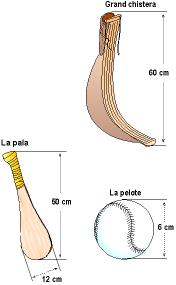
Les différentes disciplines de la pelote basque, issues du jeu de paume sont :
- La pala et la paleta qui se jouent sur un trinquet (une combinaison de murs formant un carré autour des joueurs), en mur à gauche, et en place libre. La pala se rapproche le plus du squash.
La main nue qui se joue en trinquet, en place libre et en mur à gauche. On joue les matches de 22, 30 ou 50 points, deux contre deux ou en tête-à-tête.
Parmi les grands pelotari de main nue fronton, notons l’Espagnol Titin III (13-1-69) et le Basque français Manuel Martiarena.
et
Garcia Daniel (1-5-61) ESP. Six fois champions du monde en paleta et pala.
Garrido Ricardo (20-8-62) ESP. Cinq fois champion du monde en paleta et pala.
Bergerot Arnaud FRA. Champion du monde en trinquet à paleta cuir en 2002 associé à Christophe Cazemayor.
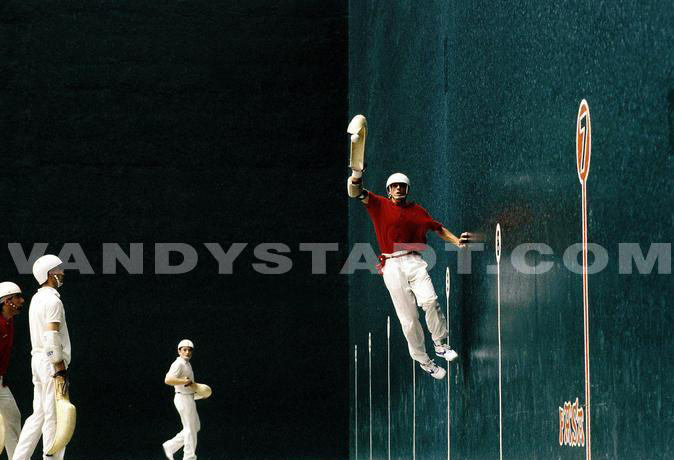
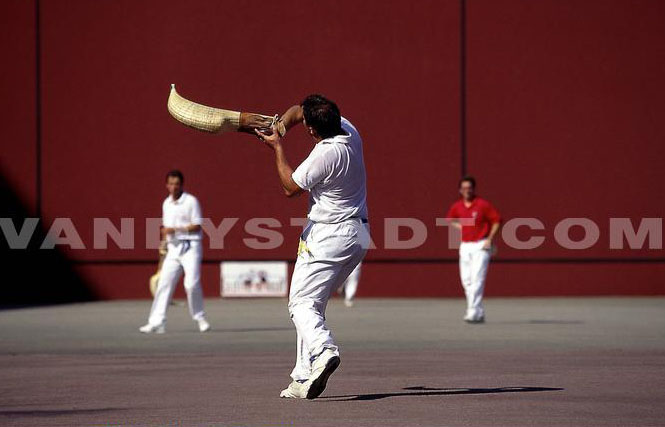
- La petite et grande chistera (panier d’osier fixé au poignet). Elle se pratique sur un fronton(place libre de 100 mètres de long et 16 à 18 mètres de largeur).
- Le petit ou “Joko Garbi” se joue en mur à gauche ou en place libre tandis que la grande Chistera se joue en place libre.
- Le rebot se joue en place libre comme le tennis, sans filet.
- La cesta punta se joue avec un grand chistera sur un mur à gauche et des pelotes beaucoup plus rapides. En 2000, les Français Pierre Etxalus et Eric Irastorza remportent la médaille d’or lors des championnats du monde.